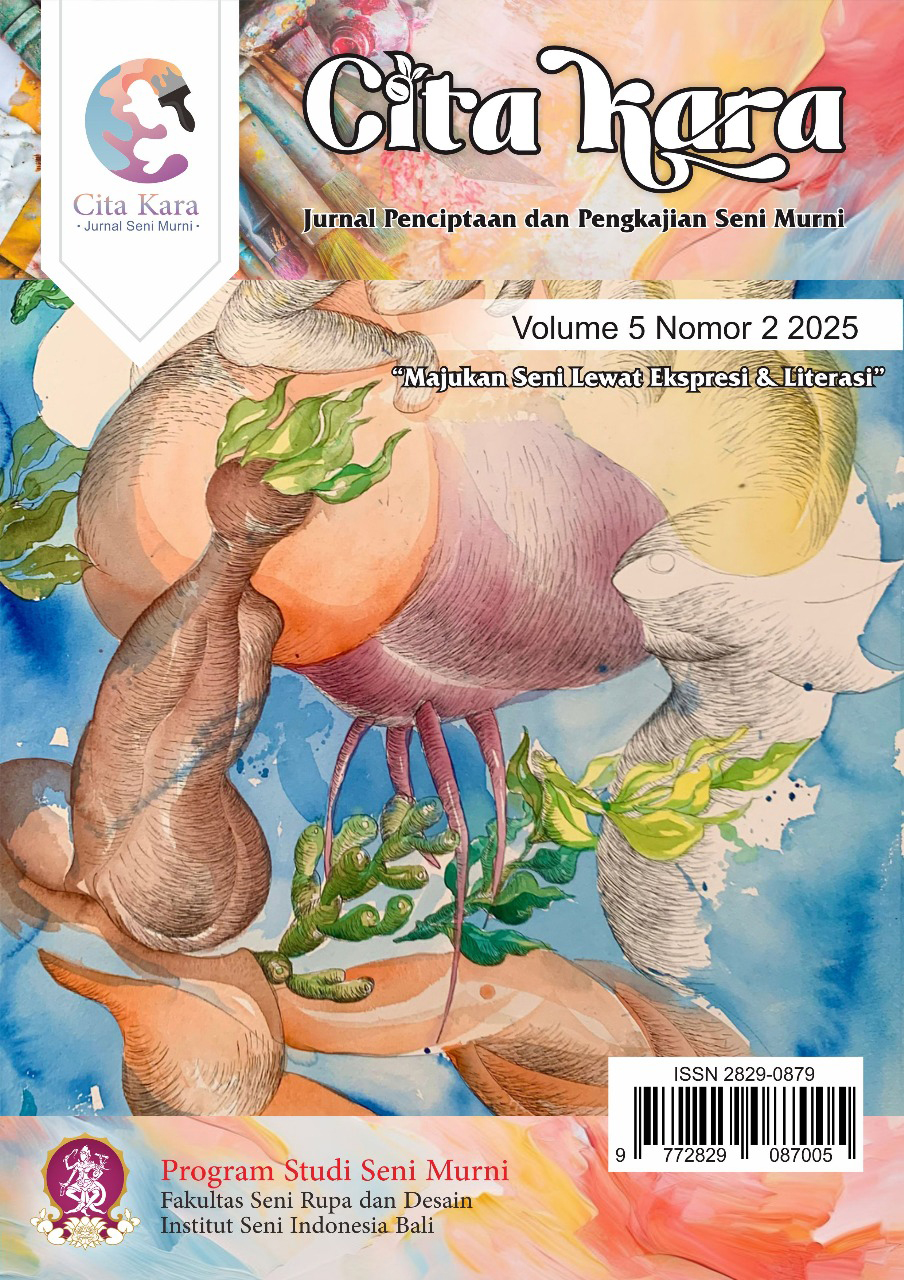
FACIAL EXPRESSIONS OF BIPOLAR COLOR: COMFORTABLE, EXCITED, CALM, LACKING SELF-CONFIDENCE, ELEGANT, ROMANTIC, AND PATIENT IN PAINTING
WARNA BIPOLAR SEBAGAI IDE UNTUK MEMBUAT KARYA SENI YANG BAIK
DOI:
https://doi.org/10.59997/ctkr.v5i2.4486Keywords:
Facial expressions, Bipolar color, Art Painting, Color psychologyAbstract
People with bipolar disorder often experience dramatic mood swings, characterized by manic, depressive and mixed symptoms. Drastic emotional changes include feelings of happiness, sadness, fear and other excessive emotions. By using the theory of color psychology, the author wants to visualize facial expressions that come from drastically changing emotional colors. These colors are combined in the opposite way like bipolar traits, resulting in new colors that are visualized in the form of facial expressions "Comfortable, Enthusiastic, Calm, Lack of Confidence, Graceful, Romantic and Patient".The method of creation is carried out through the stages of exploration or search for ideas, improvisation or experimentation, namely conducting various trials of techniques, compositions, sketch forms, blocking, combining materials, and trials of techniques such as paint melting techniques, marker and palette strokes, splashes, twig blows, and stamps; and formation, namely realizing it in the form of aesthetic works and in accordance with aesthetic works and in accordance with aesthetic and artistic experiences.
References
[1] D. Darsono, "Tinjauan Seni Rupa Modern." Surakarta: Departemen Pendidikan Nasional, 2003.
[2] K. Haller, "The Little Book of Colour: How to Transform Your Life." UK: Penguin, 2019.
[3] A. Susanto, "Perkembangan Anak Usia Dini." Jakarta: Kencana Prenada, 2011.
[4] A. Majid, B. Subiantoro, dan A. A. Muhdy, "Analisis Hasil Pembelajaran Menggambar Bentuk Siswa SMP Negeri 3 Sinjai Tengah," Jurnal Imajinasi, vol. 4, no. 1, 2020.
[5] T. M. Putra, "Ekspresi Wajah dalam Karya Lukis Surrealis," Jurnal Program Pendidikan Seni Rupa Fakultas Bahasa dan Seni Universitas Negeri Padang, 2017.
[6] C. Correia, "Susanne K Langer and The Definition of Art," EIDOS A Journal for Philosophy of Culture, vol. 2019, no. 1, pp. 92-103.
[7] I. W. Gulendra, "Pengertian Warna dan Tekstur," Konferensi Seni Rupa, Denpasar, 2010.
[8] D. Cahyadi, "Antropomorfi Mimik," Universitas Negeri Makassar, [Online]. Tersedia: https://eprints.unm.ac.id/34619/1/ANTROPOMORFI%20MIMIK.docx#:~:text=Antropomorfisme%20dalam%20mimik%20manusia%20mengacu,dengan%20ekspresi%20wajah%20mirip%20manusia.
[9] I. W. Gulendra, "Pengertian Garis dan Bentuk," Institut Seni Indonesia (ISI) Denpasar, [Online]. Available: https://repo.isi-dps.ac.id/141/1/Pengertian_Garis_dan_Bentuk.pdf.
[10] Ignite Brands, "Color Psychology in Branding: The Persuasive Power of Color," [Online]. Available: https://www.ignytebrands.com/the-psychology-of-color-in-branding/
[11] M. Palwanto, "Seni Rupa Dua Dimensi (Modifikasi) Kelas XI." Jakarta: Kemendikbud RI, Direktorat Pendidikan Menengah, Direktorat PSMA, 2020.
[12] F. Setyaningrum dan P. Probosiwi, "Modul Mata Kuliah Pendidikan Seni Rupa dan Keterampilan Semester Genap." Yogyakarta: Program Studi Pendidikan Guru SD, FKIP Universitas Ahmad Dahlan.
[13] J. Sobur, "Analisis Teks Media: Suatu Pengantar Untuk Analisis Wacana, Analisis Semiotik, Dan Analisis Framing." Bandung: PT. Remaja Rosda Karya, 2001.
[14] Universitas STEKOM, "Ensiklopedia Dunia: Ekspresi Wajah," [Online]. Available: https://p2k.stekom.ac.id/ensiklopedia/Ekspresi_wajah
[15] Wikipedia, "Pengertian Ekspresi Wajah," [Online]. Available: https://id.wikipedia.org/wiki/Ekspresi_wajah
Additional Files
Published
Issue
Section
License
Copyright (c) 2025 dewa ayu sakania pradnya aristi, I Wayan Sujana, Ni Made Purnami

This work is licensed under a Creative Commons Attribution 4.0 International License.