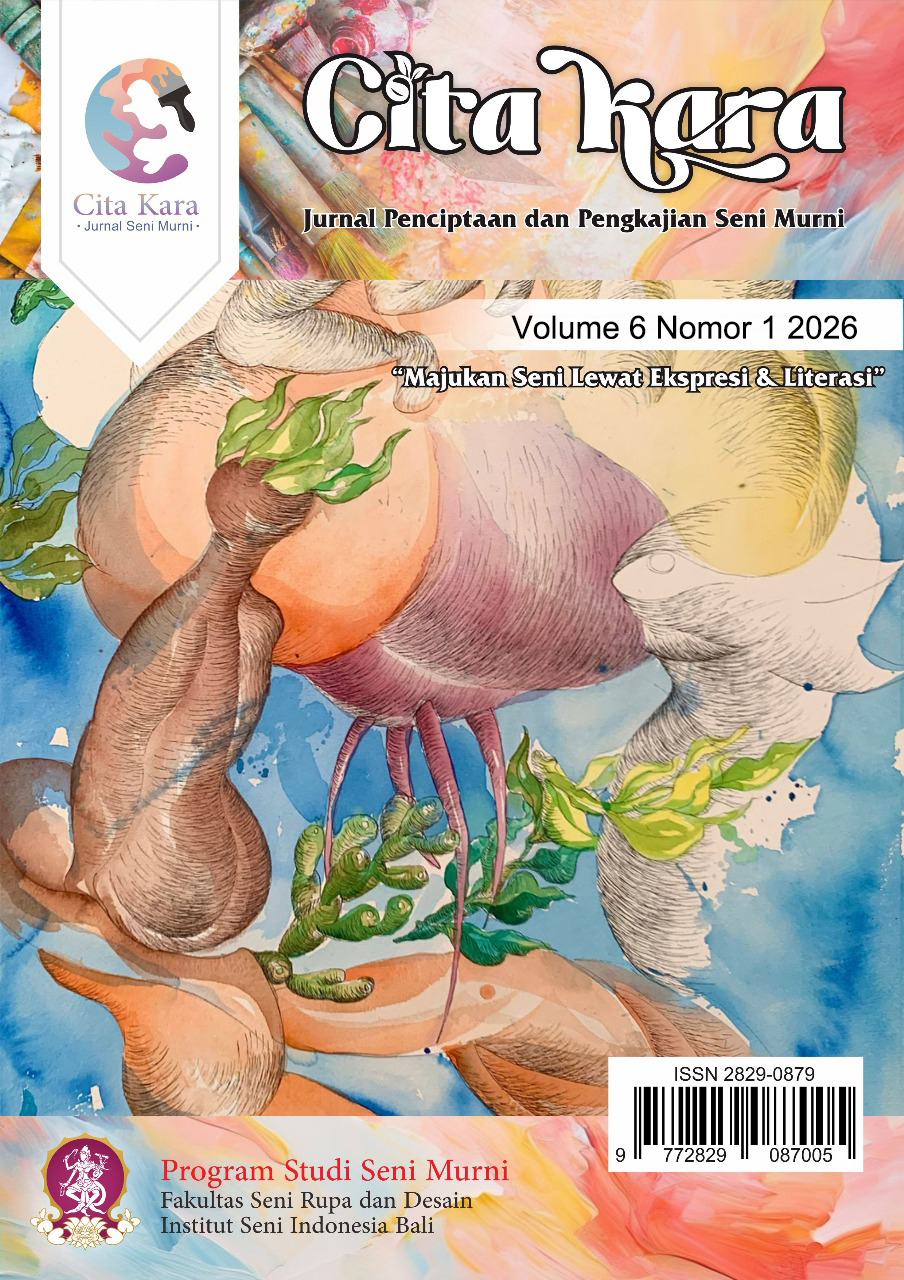
EVOLUTION TOWARDS FREEDOM: SUN GOKONG AS A SYMBOL OF HUMAN BEHAVIORAL TRANSFORMATION AS INSPIRATION FOR SCULPTURE CREATION AT THE LABDA SCULPTURE STUDIO
DOI:
https://doi.org/10.59997/ctkr.v6i1.5997Keywords:
Statue Freedom , Evolution , Transformation Sun , GokongAbstract
This study aims to create a series of sculptures that represent the philosophical concept of freedom through the symbolic transformation of human behavior, using the character of Sun Gokong as the central figure. The research adopts a practice-based approach combining additive and subtractive sculpting techniques. Various materials, including aluminum wire, resin, gypsum, and clay, were used to construct six sculptures representing stages of human development from primitive existence to spiritual awareness.
The results demonstrate that the sculptural series visualizes a gradual transformation of human consciousness, from instinctive behavior to rational and spiritually mature conditions. The final sculpture depicting Sun Gokong symbolizes the attainment of self-control and inner liberation. This study confirms that sculpture can function not only as an aesthetic object but also as a medium for philosophical reflection on human transformation and the meaning of freedom in contemporary life.
References
A. Alfin, “Pada Mahasiswa Program Studi Manajemen Pendidikan Islam Di Stit Mumtaz Karimun,” 2025.
R. H. Waskito, “Konsep Kebebasan Manusia dalam Pandangan Karl Jaspers,” Fak. Ushuluddin dan Pemikir. Islam, pp. 91–103, 2017, [Online]. Available: https://digilib.uin- suka.ac.id/id/eprint/28736/#:~:text=Kebebasan merupakan wujud eksistensi manusia,mengenai tindakan dan perbuatan manusia.
M. Satar, Abdullah, and M. Pababari, “Kebebasan Manusia Dalam Berkehendak Perspektif Musthafa Al-Ghulayaini,” Farabi, vol. 19, no. 1, pp. 68–89, 2022.
Y. Isiktac, “Isaiah Berlin: Negative and Positive Liberty,” Ann. la Fac. Droit d’Istanbul, no. 68, pp. 37–45, 2019, doi: 10.26650/annales.2019.68.0003.
I. ayu G. apsari I. G. agung P. Saraswati, “PERKEMBANGAN AJARAN BUDDHA DALAM TRILOGI PEMBEBASAN,” vol. 11, no. 1, pp. 24–40, 2025.
I. G. Paramita, “KONSEP SURGA, NERAKA DAN MOKSA DALAM KAKAWIN CANDRA BAIRAWA,” DHARMASMRTI, vol. 15, no. 28, pp. 1–138, 2016.
T. A. Wiratno, PERKEMBANGAN SENI MURNI DI ERA DIGITAL, vol. 17. Sulawesi Selatan: Alinea Indonesia, 2025.
A. L. Isvara and S. L. Ismoyo, “Seni dan Demokrasi: Pemanfaatan Ruang Publik sebagai Sarana Ekspresi, Perlawanan, dan Advokasi oleh Komunitas Taring Padi,” Irama J. Seni, Desain dan Pembelajarannya, vol. 7, no. 1, pp. 8–24, 2025, doi: 10.17509/irama.v7i1.80314.
B. SHAKTI, “MORALITAS TOKOH UTAMA SUN WUKONG DALAM NOVEL XI YOU JI KARYA WU CHENG EN ,” Bhs. Mandarin, pp. 1–5.
N. W. Ardini et al., Ragam Metode Penciptaan Seni. 2022. [Online]. Available: https://repository.penerbiteureka.com/uk/publications/559050/ragam-metode-penciptaan- seni
M. M. Nuning. W., “METODE PENCIPTAAN BIDANG SENI RUPA: Praktek Berbasis Penelitian (practice based risearch), Karya Seni Sebagai Produksi Pengetahuan dan Wacana,” Corak, vol. 4, no. 1, pp. 23–37, 2015, doi: 10.24821/corak.v4i1.2358.
H. Heldanita, “Pengembangan Kreativitas Melalui Eksplorasi,” Golden Age J. Ilm. Tumbuh Kembang Anak Usia Dini, vol. 3, no. 1, pp. 53–64, 2019, doi: 10.14421/jga.2018.31-05.
I. W. Setem, G. Y. Tjokropramono, and I. W. Gulendra, Eksplorasi Media Dan Cara Kerja Seni Lukis Ars Simia Naturae. 2024. [Online]. Available: file:///Q:/jurnal/jurnal baru/eksplorasi/BUKU EKSPLORASI MEDIA DAN CARA KERJA SENI LUKIS ART SAMIA NATURAE.pdf
A. Setia, B. Diki, and N. W. Hidayatno, “Pemanfaatan Kayu Perca Dalam Pembelajaran Seni Patung Di Kelas Ix Smp Muhammadiyah 16 Brondong Lamongan,” vol. 12, no. 1, pp. 91–100, 2024.
I. M. Aghnia, M. F. Na’am, and S. S. Sinaga, “Bentuk Visual Patung Macan Kurung Kabupaten Jepara: Analisis Semiotika Charles Sanders Peirce,” J. Pendidik. Seni Rupa Undiksha, vol. 13, no. 1, pp. 27–34, 2023, doi: 10.23887/jjpsp.v13i1.60969.
S. Smarter, “Patung Substraktif.” Accessed: Aug. 24, 2025. [Online]. Available: https://www.studysmarter.co.uk/explanations/art-and-design/art-and-design- theory/subtractive-sculpture/
S. C. Antón, “Early Homo: Who, when, and where,” Curr. Anthropol., vol. 53, no. SUPPL. 6, 2012, doi: 10.1086/667695.
T. W. Davies et al., “Dental morphology in Homo habilis and its implications for the evolution of early Homo,” Nat. Commun., vol. 15, no. 1, 2024, doi: 10.1038/s41467-023- 44375-9.
H. Chetan-Welsh, “Homo habilis, an early maker of stone tools,” Natural History Museum. Accessed: Aug. 24, 2025. [Online]. Available: https://www.nhm.ac.uk/discover/homo- habilis-early-maker-stone-tools.html
H. Widianto and S. Noerwidi, “Saatnya Menengok ke Barat: Sebuah Interpretasi Baru Tentang Distribusi Temuan Homo Erectus di Jawa,” Berk. Arkeol., vol. 40, no. 2, pp. 153–178, 2020, doi: 10.30883/jba.v40i2.598.
L. Henry, “Homo erectus, our ancient ancestor,” Natural History Museum. Accessed: Aug. 24, 2025. [Online]. Available: https://www.nhm.ac.uk/discover/homo-erectus-our-ancient- ancestor.html
C. Stringer, “The origin and evolution of homo sapiens,” Philos. Trans. R. Soc. B Biol. Sci., vol. 371, no. 1698, 2016, doi: 10.1098/rstb.2015.0237.
J. Ashworth, “Modern humans, Homo sapiens: When, where and how did we evolve?” Accessed: Aug. 24, 2025. [Online]. Available: https://www.nhm.ac.uk/discover/modern- humans-homo-sapiens-when-where-how-did-we-evolve.html
Sysilia Tanhati, “Sun Wukong, Kera Sakti yang Menantang Surga dalam Mitologi Tiongkok,” National Geographic Indonesia. Accessed: Aug. 24, 2025. [Online]. Available: https://nationalgeographic.grid.id/read/133887920/sun-wukong-kera-sakti-yang- menantang-surga-dalam-mitologi-tiongkok?page=all. Evolution Towards Freedom: Sun Gokong as A Symbol of Human Behavioral Transformation as Inspiration for Sculpture Creation at The Labda Sculpture Studio
A. K. Wulandari, “RECONTEXTUALIZATION OF SUN WUKONG ’ S HEROISM IN THE MONKEY KING FILM TRILOGY 2014 – 2018,” Paradig. J. Kaji. Budaya, vol. 13, no. 3, pp. 378–395, 2023.
Additional Files
Published
Issue
Section
License
Copyright (c) 2026 Nyoman Ferry Frasnanda, I Made Bendi Yudha, I Ketut Mustika

This work is licensed under a Creative Commons Attribution 4.0 International License.